
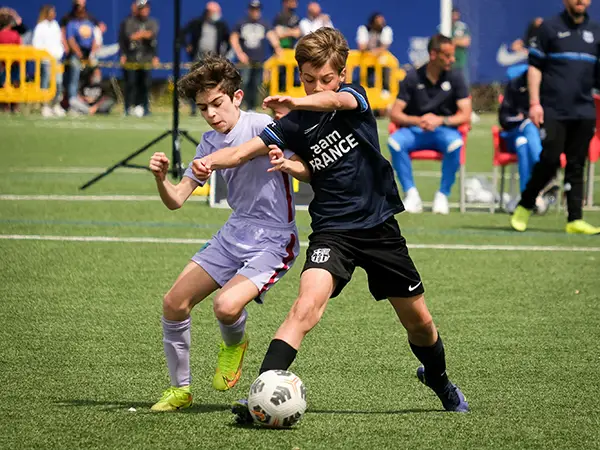
Youth fútbol in Spain is organized around weekly league competition, not showcases or tournaments. Teams train during the week and compete every weekend inside structured leagues where results, performance, and consistency matter.
Players progress through age groups, but movement is based on ability and readiness, not just birth year. Strong players are pushed up. Struggling players are challenged to adapt. Development happens through repetition and pressure, not protection.
Competition doesn’t pause. Every weekend resets the standard, and players are measured again.
Most clubs field teams across the full youth pathway, commonly:
Each age group trains multiple times per week and competes in formal leagues with promotion and relegation. There are no friendly seasons. Every match counts, and every result affects where teams and players sit within the system.
This structure is consistent across most Spanish clubs, from local sides to professional academies.
Within each age group, teams compete at different league levels depending on strength and results. Common levels include:
As teams move up, space shrinks, tempo increases, and mistakes are punished faster. Players feel the jump immediately. The game becomes quicker, more physical, and more detailed, forcing constant adjustment.
At the top are professional club academies, linked to first and second division teams. These academies set the standard, but they are not the only places where serious development happens.
Surrounding them are strong regional academies and local clubs that compete against pro academies weekly. Many players move between these environments as they develop. The ecosystem is deep, competitive, and interconnected.
This density is what drives growth. Players face different styles, coaching approaches, and opponents every week, forcing constant adaptation.
In Spain, player movement is constant and performance driven. Strong players stand out through weekly league matches, not showcases. When a player consistently performs at a high level, opportunities open naturally. That might mean training with an older age group, moving to a stronger regional club, or being invited into a more competitive environment.
Professional academies, including those connected to La Liga and Segunda División clubs, monitor these leagues closely. Recruitment is local, ongoing, and based on repeated performance over time. Players are identified through league play, recommendations, and direct observation, not one off events. Progression happens step by step, moving through stronger teams, higher league levels, and environments with tighter standards.
There are no shortcuts. Advancement comes from consistency, adaptability, and proving yourself week after week against better opposition.
Spanish youth football is built on:
There’s no hiding. Players learn to think faster, move smarter, and compete with purpose because the environment demands it every week.
Understanding this pathway helps teams and families decide when stepping into Spain makes sense and what preparation it actually requires.
Experiencing the System Firsthand
For teams and players who want to experience this environment firsthand, there’s no substitute for stepping into it. Training, competing, and living inside the Spanish system is how the differences become real.